| Posted March 17, 2021

The Academy of Change (AoC) Has Kicked-Off its Third Round

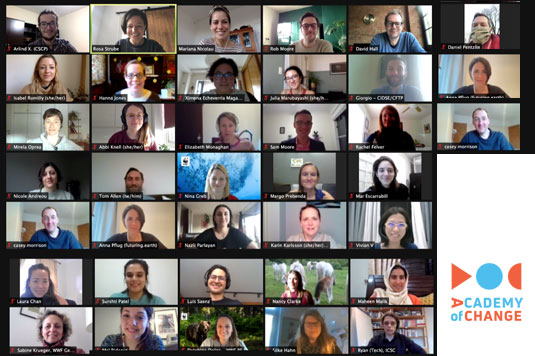
Having previously trained over 100 representatives of non-governmental organisations (NGOs) from more than 25 countries, the Academy of Change (AoC) capacity building programme has launched its third round. The programme, a uniquely designed format, supports NGOs to increase their impact by integrating behavioural insights into their work. The third round of the Academy of Change (AoC) has gathered 45 NGOs from around the globe, including representatives from Greenpeace International, World Wide Fund for Nature (WWF) and Care International. The goal of the programme is to unlock the power of practical applications of behavioural knowledge in accelerating the transition toward sustainable behaviours […]

| Posted

Our weiter_wirken Capacity Building Programme Wraps Up Successfully

Be it promoting biodiverse gardens, boosting sustainable fashion or fostering more sustainable food choices, our capacity-building programme weiter_wirken supported non-governmental organisations (NGOs) to increase the impact of their projects by successfully incorporating behaviour change know-how. The programme, which started in October 2020, offered a four-part workshop series to help participants design effective behaviour change interventions for better results in their projects. Having taken the participants through the stages of designing and implementing behaviour change interventions, the final workshop, held virtually in March 2021, focused on evaluation as the final step in the process of changing behaviours. Evaluation ensures that success as […]

| Posted

Green Horticulture in Kenya: Opportunities and Challenges for Farmers

How can Kenyan farmers increase the market share of their produce both locally as well as in Europe? What is holding them back and how to overcome those barriers? The report “Introducing Green Horticulture at Lake Naivasha in Kenya”, as part of our GOALAN project, offers an enhanced analysis from a local and international perspective as well as suggestions for the way forward. Horticulture farmers with micro, small and medium-sized enterprises (MSMEs) have been contributing to an upward trend in agriculture around the Lake Naivasha Basin (LNB) in Kenya. They have significantly increased the country’s fresh fruit and vegetable (FFV) supply. […]

| Posted March 10, 2021

Circular Packaging from a Consumer Perspective

Many companies shy away from converting well-established packaging, knowing that routine and recognition effects are of enormous importance for the purchasing habits of consumers. But, since a great portion of today’s packaging is not yet recyclable, change is inevitable. So, how can the transition to more sustainable packaging succeed? As part of the Consumer Insight Action Panel (CIAP) packaging club, we accompanied new packaging pilots to find solutions. Modern packaging has many aspects to consider: it must protect products and bring them safely to consumers, be reasonable in cost, easy to handle, and efficient to transport. On the shelf, it should […]

| Posted March 9, 2021

A New Framework for Enabling Circular Business Models in Europe

Shifting to a circular economy in Europe is highly dependent on reducing resource use, lengthening the lifespan of products as well as boosting their reuse and shared use. Repairing, remanufacturing, and recycling are also important elements. Circular business models are thus crucial: but, what type and how to successfully implement them? The ETC-WMGE report “Business Models in a Circular Economy” presents an analytical framework to study the successful implementation of circular business models. Developing appropriate business models is a key enabler in implementing circular economy goals. The term circular business model has, however, become something of a buzzword, with many different […]

| Posted March 4, 2021

The CSCP Welcomes the European Parliament’s Demand to Curb Overconsumption

In an attempt to bring European consumption and production patterns within planetary boundaries, the EU Parliament has recently demanded the first-ever EU targets to reduce overconsumption by 2030. Having worked for 15 years toward sustainable consumption and production (SCP) practices, the CSCP is looking forward to tapping into this new momentum and collaborating for a resilient economy. Be it through boosting the repairability of products, supporting prosumerism or replacing conventional business models with product-as-a-service systems or access-based models, the CSCP is committed to mainstreaming sustainable solutions. In the key plenary vote held in February 2021, EU lawmakers have called for the […]

| Posted

Listen to Episode 4 of our Academy of Change Podcasts: Evaluation of Behaviour Change Interventions

Changing behaviours is an integral part towards sustainable lifestyles. But how do you know whether the intervention toward a more sustainable behaviour really worked? In this episode, we close the loop of behavioural interventions by talking about evaluation. Listen to our conversation with David Fell who shares his expertise on the importance of evaluating interventions and how to actually do that. Evaluation is the final step in the course of designing and implementing a behaviour change intervention (Listen to our previous podcasts about each step). It is not only about collecting data and measuring indicators but also about understanding whether what […]

| Posted March 3, 2021

Join Our Online Workshop “Digital Sustainable Value Chains” – 18 March 2021!

How can digitalisation enable sustainable business models and the circular economy? What does this mean in practice for Small and Medium-Sized Enterprises (SMEs)? In a recent series of online events, the Competence Centre eStandards has approached these questions from multiple angles and in different formats, aiming to support SMEs make the most of digitalisation in their aim to become more resilient and thrive. The next Competence Centre eStandards participatory event, the workshop Digital Sustainable Value Chains, will look at the potential of digitalisation in ensuring transparency and sustainability along the entirety of value chains. From a strict SME perspective, the workshop […]

| Posted

Breakfast Inspiration To Go: Join our Event “Opportunities and Risks of AI Applications in SMEs” – 11 March 2021!

Digitalisation is one of the most transformative trends of our time and Artificial Intelligence (AI) – as one variant of technology application – is expanding rapidly. With the profit rationale as the main driver behind the development of AI applications, ethical and sustainability-related questions have gained a new degree of urgency. With a finger on the pulse of the matter, the Competence Centre eStandards has launched the “AI for early birds” online series to address challenges and opportunities of AI applications in small and medium-sized enterprises (SMEs). There is much that SMEs can benefit from AI applications: optical pattern recognition in […]

| Posted

How the Circular Economy Can Support Perú Recover from COVID-19 and Prosper

Be it to mitigate the pandemic’s effects and recover or generate sustainable growth, circular economy has much to offer for the world-renowned touristic destination, Perú. High-relevance sectors such as tourism, fishing, agriculture, manufacturing, and construction could particularly benefit by endorsing circular approaches that make them more resilient. In two virtual events hosted by the EU representation in Perú, the CSCP’s Executive Director, Michael Kuhndt, shared European insights on sustainable consumption and production approaches and how those could support the Peruvian circularity journey. Kuhndt discussed the latest trends and policy in view of major strategic frameworks, such as the EU Green Deal […]