| Posted September 22, 2022

Upskilling and Reskilling: How the CATALYST Project Will Support SMEs to Transform

Just around one percent of German companies are not a small or medium-sized enterprise (SME). With the necessary skills, SMEs can play a decisive role in shaping Europe’s sustainable future. But, how can they prepare their workforces for this? On 19 and 20 September, 16 project partners from 5 European countries came together in Skopje, North Macedonia, to launch the Catalyst project. The project goal: to make the European workforce fit for the future! At the the kick-off, the project lead Prof. Angelina Taneva-Veshoska from the North Macedonian Institute for Research in Environment, Civil Engineering and Energy (IECE) stressed the urgent […]

| Posted September 20, 2022

Toward a European Bioeconomy: Don’t Miss Our Scalibur Project Final Event on 19 October 2022!

Rethinking municipal solid waste management is a central element in the transition to a circular and bio-economy. Yet, this remains a significant challenge for many European cities. A successful implementation of a circular and bio-economy needs to account for a reduction in the amount of (bio)waste deposited in landfills while enhancing the share of (bio)waste that can be returned to the system after recycling. In the course of four years, the SCALIBUR project worked together with a wide array of stakeholders to inspire a revolution in urban (bio)waste recycling in Europe. Leading waste management companies, technology developers and research organisations have […]

| Posted

“We Need to Come Together Around Purpose!”

Alexander Mannweiler has joined the CSCP as Senior Project Manager in the Sustainable Infrastructure, Products, and Services (SIPS) team. Currently, his focus is on promoting awareness for biodiversity in businesses and business associations in Germany as part of the UBi (Business & Biodiversity) project. In this interview, he shares his ideas on how to make positive change happen. How do you think you can make a positive change as part of the CSCP? Sustainability is certainly a complex topic, that’s why it often gets ‘stuck’ in many organisations. I believe that with a systematic and holistic approach to sustainability we can […]

| Posted

Join our Digital Dialogue: How New Legislation Can Help Preserve Biodiversity & What This Means for Businesses

For many companies, the environmental and social impact of their supply chains is significantly higher than the impact of their operational business. As of 2023, the German Supply Chain Sourcing Act and the EU Code of Conduct for Responsible Business and Marketing Practices will require companies to take responsibility for their supply chains. Our UBi (Business & Biodiversity) project Digital Dialogue looks into one key question: How can companies use this as a chance to rethink their supply chains from a biodiversity perspective and what is the added value for them? Supply chains that focus on biodiversity are more resilient to […]

| Posted September 19, 2022

“Understanding Social Norms Holds the Key to Sustainable Consumption”

For the Argentinian psychologist, Maria Victoria Ortiz understanding social dilemmas and what hinders or propels cooperation in society is an ongoing fascination. Her doctoral research focuses on consumption behaviours and lifestyles and how those could hold the key to counter an aggravating climate crisis. Ortiz, who is a Green Talents awardee, uses an experimental climate game approach to understand the (dis)connection from present to future generations. She chose the CSCP for her Green Talent research stay, engaging closely with our Sustainable Lifestyles (SL) Team. The research stay abroad is a key element of the Green Talent Programme. How did you come […]

| Posted September 15, 2022

CHORIZO: Our New Horizon Europe Project to Tackle Food Loss and Waste Through Social Norms

The three-year CHORIZO project will take an innovative approach to tackling food loss and waste through gathering insights on social norms in a range of food-related settings and generating effective ways to apply behaviour change techniques in six real-life case study contexts. Food loss and waste (FLW) is a topic with far-reaching consequences across the spectrum of economic, environmental and social spheres. It’s also a topic that involves a range of different actors from agriculture through to end consumers. While behaviour change around FLW has attracted a lot of attention for a number of years, the CHORIZO project, which stands for […]

| Posted September 14, 2022

Sustainable Digitalisation as a Competitive Advantage for SMEs: Join our CSR.digital Event on 20 October 2022!

Since 2020, the CSR.digital project has been working with entrepreneurs in North Rhein-Westphalia, Germany (NRW) to develop a wide range of ideas and strategies on how to implement the twin transformation to a digital and sustainable economy. On 20 October 2022, the project team along with Mona Neubaur, NRW Minister of Economic Affairs, will share key learnings and how those could benefit other companies to transform. At the event, you will learn first-hand from innovative companies what competitive advantages a sustainable orientation of your digital strategy can bring and how digital technologies can practically support the implementation of mega trends such […]

| Posted September 13, 2022

Flexible Circular Plastics: Join Our Circular Week Webinar on 5 October!

Durable, light, low-cost and with good barrier properties – flexible plastics are a leading material in packaging applications in consumer goods, construction, and agriculture. However, their reuse potential is limited, making flexible plastics a drain on Europe’s resources and a serious pollution threat. This is why innovative solutions are needed in order to keep them in the loop for as long as possible. As part of the Circular Week 2022, our session “Flexible Plastics in Europe’s Circular Economy” gives an overview of the current management practices as well as viewpoints to increase circularity of flexible plastics on a European scale in […]

| Posted

HOOP Lighthouse Cities Share Experiences on Circular Bioeconomy

Biowaste management practices vary greatly around Europe. As part of our HOOP project, stakeholders from ten European cities and regions visited Münster, Germany and Almere, in the Netherlands to learn more from these two frontrunner cities. The inaugural study tour links to the project’s overall aim to improve urban biowaste management practices, such as separate collection and valorisation. A central goal of the tour was to foster cross-city learning: “It’s not only really important to develop tools to foster European circular bio-economy, you also have to guarantee that other parties across Europe or worldwide have the opportunity to understand what you […]

| Posted September 9, 2022

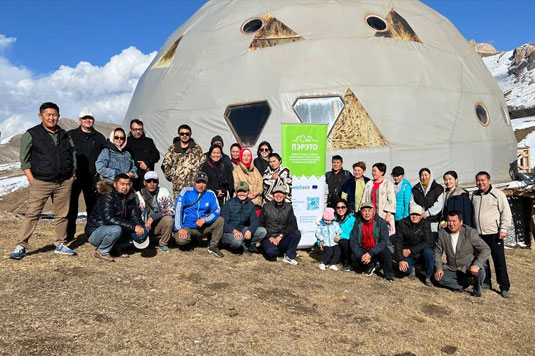
Sustainability Hacks To Go: How Our PERETO Project is Promoting Sustainable Consumption in Kyrgyzstan

Studies suggest that consumers are responsible for as much as 60-70 % of all direct and indirect greenhouse gas emissions*, pointing to an urgent need to change consumption habits and endorse more sustainable lifestyles. Through an awareness-raising campaign, our PERETO project is inspiring Kyrgyz citizens as well as international tourists to consume in more sustainable ways. PERETO, which stands for ‘Promotion of Energy Security and Sustainable Growth Through Increased Energy and Resource Efficiency (ERE) in Tourism SMEs in Kyrgyzstan,‘ aims to support the advancement of sustainable production and consumption (SCP) practices and energy and resource efficiency (ERE) among SMEs in Kyrgyzstan’s […]