| Posted December 3, 2020

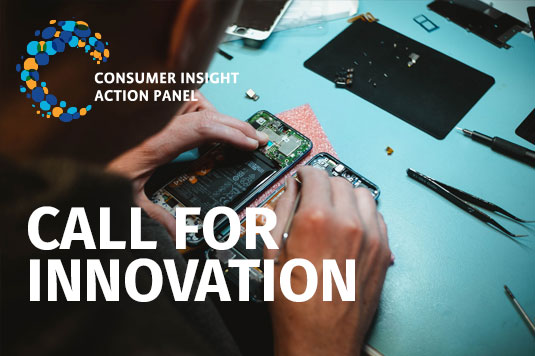
Call for Innovation: Let’s Crowdsource Solutions that Foster Circular Behaviours!

How can we improve take-back schemes in order to motivate consumers to return their old electronics to the right collection points? How can behaviour change interventions support consumers in exercising their right to repair? What are the best ways to enable consumers in choosing repairable electronics? Are you aware of ideas or innovative solutions in addressing these questions? Get in touch with us and let’s foster circular behaviours together! Electronics have become an indispensable part of people’s lives. Each European generates about 16.6kg e-waste per year, from which less than 40% is recycled*. Carbon emissions, resource depletion, and social implications are […]

| Posted

Capacity Building Programme “weiter_wirken” Started: Communicating Sustainability Successfully

Changing behaviours of people toward acting and consuming more sustainability is complex — a major challenge being the intention-action gap — we intent to be sustainable but our actions don’t reflect that. Tackling this requires generating solutions that make it easier to change habits in long-lasting ways. Our training programme weiter_wirken aims to support non-governmental organisations (NGOs) in building a community of practice dedicated to achieving more sustainability in North-Rhein Westphalia (NRW). Twenty-two NGO professionals and volunteers embarked on the four-module workshop training programme, which launched virtually in October 2020. Building upon the success of our international capacity building programme, the […]

| Posted December 1, 2020

Consumer Behaviour in the Circular Economy

The transition from a linear to a circular economy is one of the most important imperatives of our time, a transition that requires a fundamental change in the way we produce and consume. A circular approach to production and consumption reduces emissions and pollution, increases competitiveness, and boosts innovation – in short, it makes our economies and societies more sustainable and resilient for the future. At a European level, the EU Green Deal sets an important strategic framework to guide, promote, and push towards a Circular Economy. The Circular Economy Action Plan entails initiatives along the entire life cycle of products […]

| Posted November 24, 2020

Circular Economy at a City Level

Imagine a city that promotes the transition from a linear to a circular economy in an integrated and inclusive way by collaborating with municipalities, utility companies, citizens, businesses, and the research community to develop and test business models that decouple resource use from economic growth. A city that maintains the value and utility of products, resources, and materials for as long as possible in order to close the loop and minimise new resource use and waste generation. A city that through public procurement and investment budgets drives demand for circular products and services. And by doing all of this, improves human […]

| Posted November 17, 2020

Join Our CSR.digital Online Conference “Digital Leadership” on 8 December 2020

In times when working remotely has become the new normal, many organisations, including Small and Medium-Sized Enterprises (SMEs), are facing numerous challenges: how to build trust in remote teams, maintain a feeling of togetherness, and ensure long-term employee satisfaction? CSR.digital will address these questions with a group of experts during the online conference “Digital Leadership – Rethinking Leadership, Staying Competitive”, 8 December, 09:30-12:30 CET. Register here to join the discussion! On top of megatrends such as digitalisation and sustainability, the ongoing pandemic has put conventional corporate management to a test. The pandemic is also acting as an accelerator of change by […]

| Posted

How Vaude Innovates with ‘Product-As-a-Service Business Models’

How many times a year does one use a drilling machine, a backpack or a tent, if at all? Most likely, just a couple of times. Despite that, consumers spend a lot of money on products that, after sporadic use, are stored for most part of the year. The story of Vaude is an example of the potential of renting models and their multiple benefits for companies and customers alike. During the R2Pi project, the CSCP collaborated with the German clothing and outdoor company Vaude on a “Product-As-a-Service Business Model”. In one in-house strategy workshop with key participants of the relevant […]

| Posted November 12, 2020

Join Our Webcast “Putting Solutions in the Shopping Basket” on 19 November 2020

How can retailers in the food sector play an active role in supporting the transition towards healthier and more sustainable food consumption in view of the Farm to Fork Strategy, part of the EU Green Deal? What can we learn from behavioural interventions applied in real-life contexts and what is the way ahead to scale them up? To find answers to these questions, join us on 19 November 2020, 15:00-16:30 CET, at the Virtual @EATHome Newscast! The interactive webinar ‘Putting solutions in the shopping basket: food retailer approaches and interventions to support more sustainable food consumption’, brings together EU policymakers, food […]

| Posted

CSCP Appointed to the Sparkasse Wuppertal Sustainability Committee

Banks and other financial institutions have been increasingly in the spotlight in the face of growing expectations related to their role in addressing environmental, social, and governance (ESG) concerns. The Coronavirus pandemic has brought certain sustainability aspects, such as emergency readiness or resilience capacities, even more to the fore. To be fit for a changing world and proactively engage in higher social and environmental aims, Sparkasse Wuppertal has set up its Sustainability Committee, to which Michael Kuhndt, CSCP Executive Director, has been appointed. The committee members, which are experts in the fields of business and science, will advise the Sparkasse Wuppertal […]

| Posted November 10, 2020

Product Responsibility as Value and Revenue Generator: The Case of Rockwool

The construction industry accounts for 40% of global energy use, 30% of energy-related greenhouse gas emissions, approximately 12% of water use, and nearly 40% of waste*. Green buildings can not only curb the footprint, but also be a catalyst to address major policy frameworks such as the Sustainable Development Goals (SDGs), by ensuring health and wellbeing for all ages, making sustainable and affordable energy accessible to everyone, and supporting communities to live safe and resilient lives. We would like to share our experience with Rockwool – a best practice example of sustainable action in the construction sector. As part of the […]

| Posted November 9, 2020

The Academy of Change Call for Applications is Open – Apply by 15 January 2021!

Are you a non-governmental organisation (NGO) and looking to scale up your impact? Our successful Academy of Change (AoC) programme is a unique opportunity for state-of-the-art knowledge on how to enable sustainable behaviour change in practice. The call for application for the third round of the AoC is open – apply now! Embracing more sustainable behaviours and lifestyles has never been higher on the agenda. The current Coronavirus pandemic has unravelled the ample potential for behaviour change across societies globally, but also the sustainability challenges and social inequities that we are faced with. Acknowledging the role of people’s behaviours in shaping […]